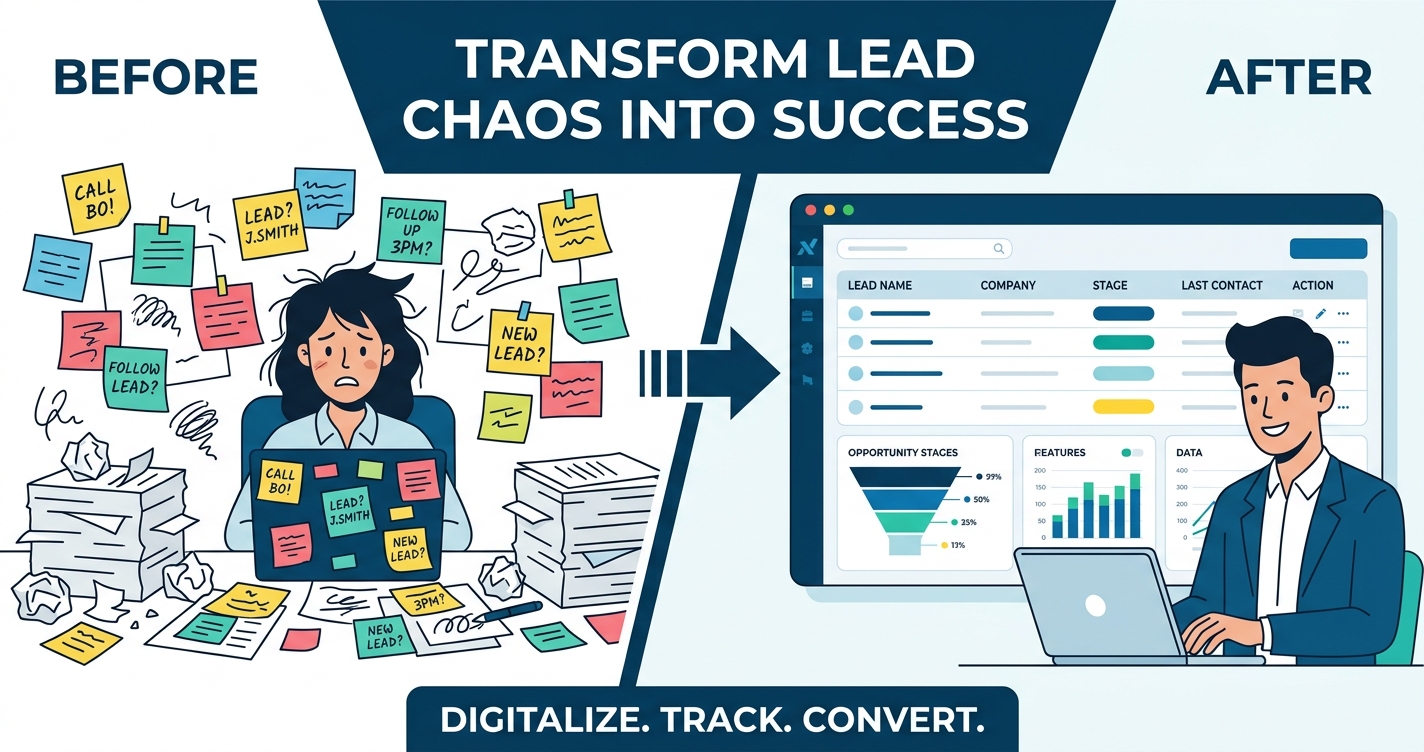
The Lead Management System Every Small Business Needs
You got 12 leads this week. Quick: where are they now? Which got quotes? Which are waiting on you? Which went cold?
If the answer lives in your head, your inbox, and a sticky note — you don't have a system. You have a leak.
The 5 Components of a Real Lead Management System
- Capture — every call, text, form, and DM lands in one place automatically. If a lead can reach you, it enters the system.
- Qualification — hot, warm, or cold, scored at first contact. Hot leads get you; warm leads get automation.
- Pipeline — a visual board: New → Contacted → Quoted → Won/Lost. Every lead has a stage and an owner.
- Follow-up — automated sequences so no lead depends on your memory.
- Reporting — leads in, conversion rate, revenue out. What gets measured gets fixed.
Why Spreadsheets and Inboxes Fail
They don't remind you. They don't follow up. They don't answer the phone at 9 PM. A lead management system isn't a place to store leads — it's a machine that moves them.
The One-Number Test
Ask yourself weekly: how many leads came in, and how many became customers? If you can't answer in 10 seconds, that's the first problem to solve. In Nexxy, that number is on your dashboard the moment you open it.
What Changes When the System Runs
| Before | After |
|---|---|
| Leads in 5 different inboxes | One pipeline, everything captured |
| Follow-up when you remember | Automatic, every lead, every time |
| "I think we're busy" | Exact conversion numbers weekly |
| Old leads forgotten | Nurture sequences until ready |
Conclusion
You're already paying for leads — with ads, with reputation, with years of work. A lead management system makes sure you keep what you paid for.
The Capture Layer: Every Door Into Your Business
Leads arrive through more doors than you think: phone calls, texts, website forms, Google Business messages, Facebook DMs, Instagram, referrals texting your personal cell, even walk-ins. A real system captures all of them into one timeline. If a lead can reach you through a channel, that channel feeds the CRM — automatically. The moment capture is complete, everything downstream becomes possible.
The Single Timeline Principle
The killer feature of a proper system isn't the pipeline view — it's the unified timeline: every call, text, email, quote, and note for a customer in one thread. When a customer calls back after three months, you (or your AI) see the whole story instantly. No "remind me what we discussed?" — the fastest way to sound like you don't care.
Ownership and Accountability
Every lead needs one owner at every moment — even if the owner is an automation. "Everyone's job" is nobody's job, and leads die in the gaps. With Nexxy, the AI owns response and follow-up by default; humans own the conversations that need judgment. Nothing floats unclaimed.
The Weekly Review Ritual
Fifteen minutes, same time weekly: How many leads came in? How fast were they answered? How many quoted? How many closed? Where are deals stuck? A system makes this review possible; the review makes the system valuable. Data you never look at decorates dashboards but changes nothing.
Common Lead Management Failure Modes
- The hero trap — owner personally handles everything; works until it doesn't, then collapses at ~30 leads/month
- The tool sprawl — five apps, none connected, leads copied by hand (or not)
- The front-loaded funnel — all energy on new leads, none on follow-up; the most expensive leads ignored
- The memory system — "I remember everyone" — until the week you don't, which costs you the biggest job of the quarter
Building Yours This Week
You don't need a consultant. Connect your phone line and forms, define your five pipeline stages, turn on instant response and quote follow-up, and review the numbers Friday. A working lead management system is an afternoon of setup and a weekly fifteen-minute habit — not a software project.
Start Your Free Trial | Watch Demo
Related: Build a Sales Pipeline | Speed to Lead