Email Marketing Automation That Doesn't Feel Like Spam
The average person gets 121 emails a day and deletes most of them unread. So why bother? Because done right, email still delivers one of the highest ROIs in marketing — and automation means it runs while you work.
Spam vs. Welcome: The Difference
Spam is unwanted, generic, and frequent. Good email is expected, personal, and useful. Every automated email should pass one test: would the recipient be glad this arrived?
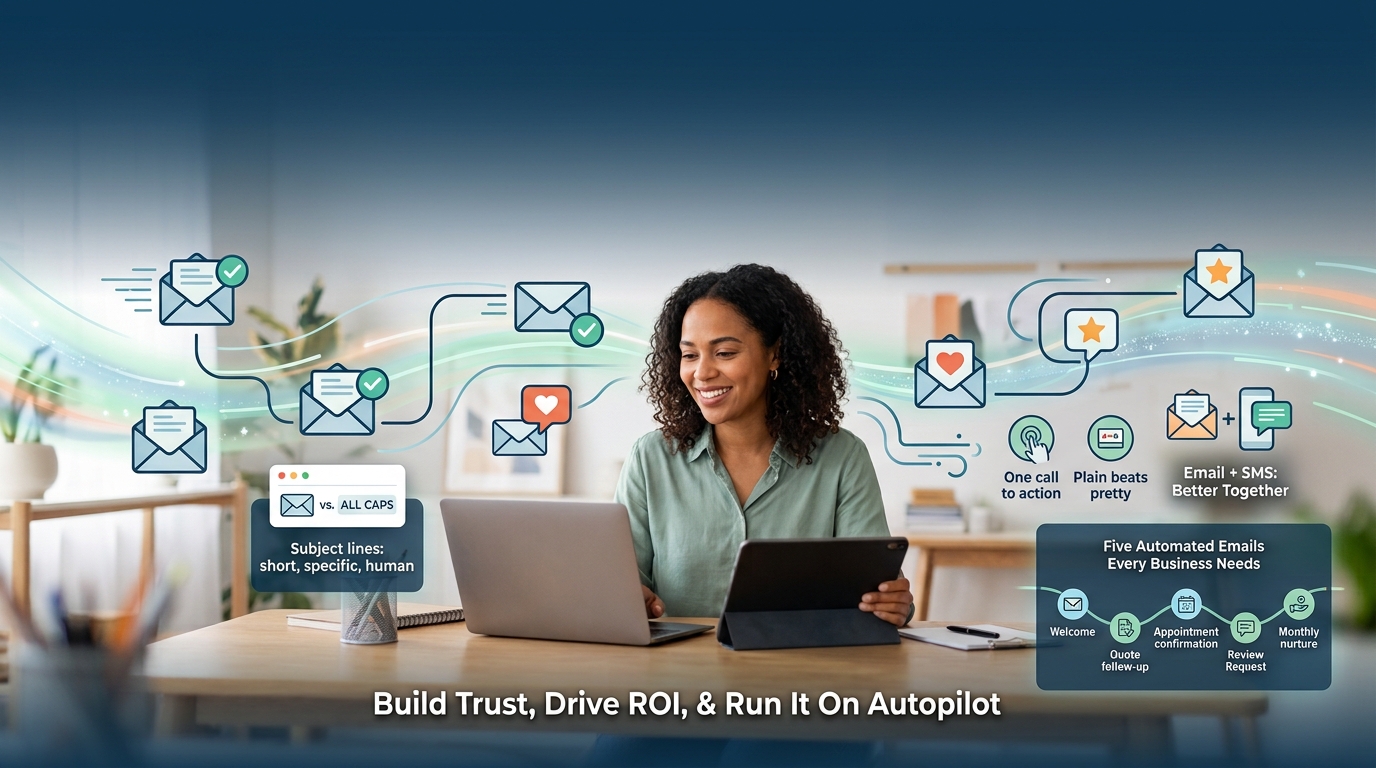
The Five Automated Emails Every Business Needs
- Welcome — sent the moment someone becomes a lead or customer. Sets expectations, delivers value immediately.
- Quote/proposal follow-up — the deal-nudger sequence: value, objection-handling, gentle close.
- Appointment confirm + prep — reduces no-shows and makes you look buttoned-up.
- Post-service review request — timed to peak happiness.
- Monthly nurture — tips, seasonal reminders, light offers. Keeps you top-of-mind for "not yet" leads.
Writing Emails People Open
- Subject lines: short, specific, human. "Your quote is ready" beats "EXCITING OPPORTUNITY!!!"
- One idea per email — a newsletter is not a novel
- One call to action — one button, one link
- Plain beats pretty — text-style emails from "Mike at Summit Roofing" outperform glossy templates for local businesses
Email + SMS: Better Together
SMS for urgency (reminders, text-backs, same-day offers). Email for depth (proposals, newsletters, education). In Nexxy, both channels live in one sequence — a lead might get an instant text, a day-3 email, and a day-7 text, all automatic.
Conclusion
Email isn't dead — lazy email is. Automate the messages your customers actually want, and your list becomes a revenue asset that compounds monthly.
Subject Lines That Work for Local Business
Curiosity and specificity beat cleverness: "Your estimate is ready" / "A thank-you (and a question)" / "We're booked out two weeks — here's why" / "The one thing that kills water heaters." Avoid ALL CAPS, excess punctuation, and anything you'd be embarrassed to send a friend. If it would feel at home in a personal inbox, it'll get opened.
The Monthly Newsletter That Doesn't Get Deleted
Structure that survives the inbox: one useful tip (seasonal, relevant to your trade), one piece of proof (a review or finished project photo), one soft offer. Three short sections. The ratio matters — lead with value and the offer gets read; lead with the offer and everything gets deleted.
Segmentation Without a Data Team
Three segments cover 90% of the value: active customers (they want reminders and loyalty offers), open leads (they want reasons to decide), and dormant contacts (they want a reason to come back). Same email engine, three versions of relevance. Even this crude split doubles response rates versus one blast to everyone.
Deliverability Basics
Use a proper sending platform (never your personal Gmail for bulk), keep your list clean (remove bounces and the perpetually unengaged), warm up slowly, and make unsubscribing one click. Deliverability is a reputation you build daily and lose once. The boring rules are the whole game.
Automated vs. Broadcast: Use Both
Automated flows (welcome, follow-up, review, win-back) run forever and do the revenue work. Broadcasts (newsletter, seasonal offer, announcement) keep the relationship warm. Businesses that run only broadcasts burn their lists; those running only automations feel robotic. The blend is the brand.
Reading Your Numbers
Opens tell you about subject lines (target 30%+ for a warm local list), clicks tell you about content, replies tell you about trust — and replies are the metric that matters most for a service business. An email that starts conversations is worth a hundred that get passively opened.
Start Your Free Trial | Watch Demo
Related: SMS Marketing Guide | Automate Follow-Up