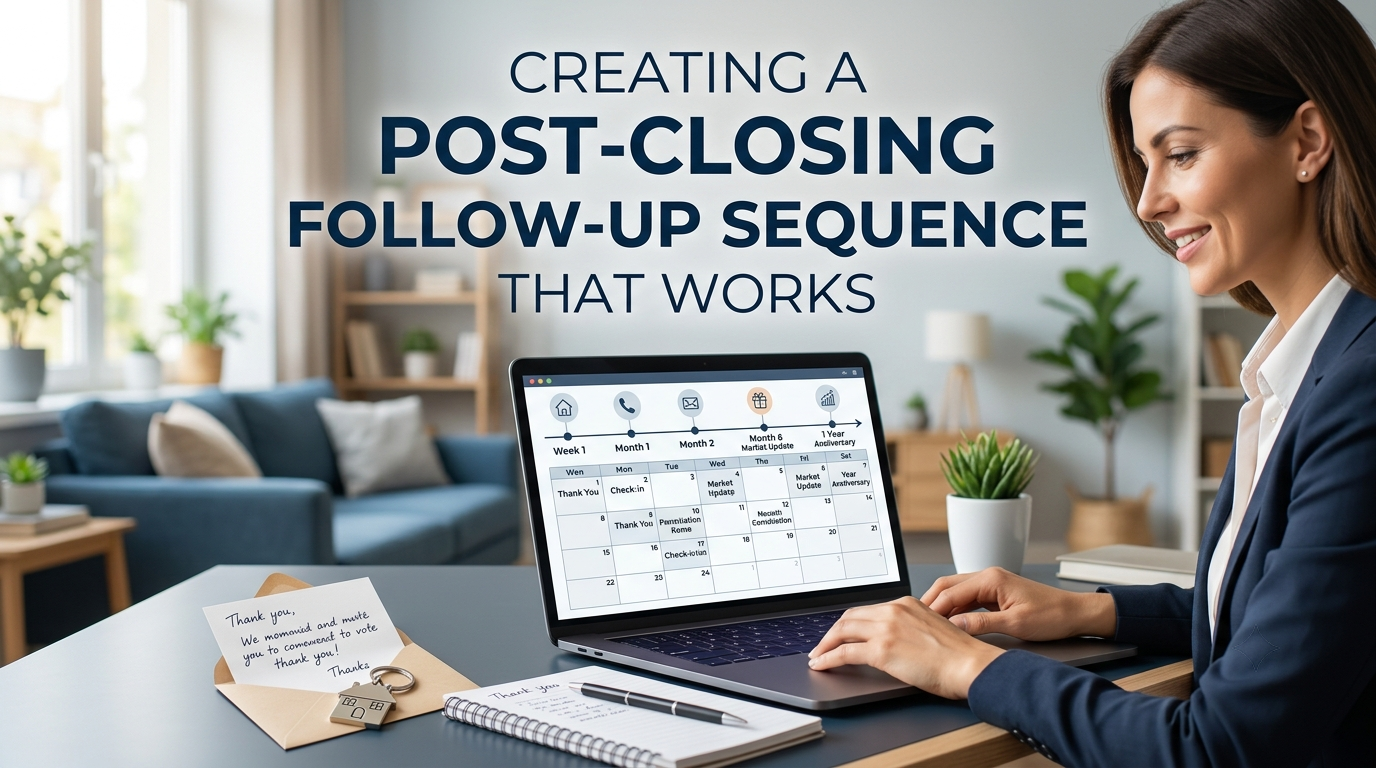
Why Closing Day Is the Start, Not the End
The moment a transaction closes is often treated as the finish line of an agent-client relationship. In reality, it's the point where the highest-value phase begins. A client who just closed is at peak gratitude and peak trust, and how an agent handles the months that follow largely determines whether that client becomes a source of repeat business and referrals or simply fades into a closed file.
Most agents don't have a plan for this period. They rely on memory or good intentions, which means the sequence happens inconsistently, if at all. A defined post-closing follow-up sequence real estate professionals use removes that uncertainty and ensures every client receives the same level of care, regardless of how busy the agent's pipeline is at any given moment.
The Core Post-Closing Sequence
A reliable post-closing sequence follows a predictable rhythm, front-loaded in the first year and then settling into a steady, lower-frequency cadence.
| Timing | Touchpoint | Purpose |
|---|---|---|
| 1 week after closing | Personal thank-you | Reinforce the relationship beyond the transaction |
| 1 month after closing | Check-in call | Confirm they're settled, address lingering questions |
| 3 months after closing | Seasonal home tips | Provide genuine, non-sales value |
| 6 months after closing | Local market update | Reinforce their decision, demonstrate ongoing expertise |
| 12 months after closing | Anniversary note with equity update | Celebrate the milestone, open the door to referrals |
| Ongoing (year 2+) | Quarterly touchpoints | Maintain visibility, stay top of mind |
This structure balances two goals: staying present enough that the relationship doesn't fade, and staying light enough that the outreach never feels like a sales campaign in disguise. Building a post-closing follow-up sequence real estate agents can sustain is the key to long-term retention.
What to Say at Each Stage
The one-week thank-you should be personal and specific, referencing something particular to that client's experience rather than a generic template. A handwritten note or a thoughtful, small gesture tends to land better than a form email.
The one-month check-in should focus entirely on the client's transition into their new home, not on future business. Asking how they're settling in, whether they've run into any issues, and offering to help with a lingering question demonstrates ongoing care.
The three-month seasonal touch should offer genuinely useful information relevant to their specific property, such as maintenance tips appropriate to the season and their home type. This is a value-first touchpoint with no ask attached.
The six-month market update should show how their neighborhood has performed since closing, framed around reinforcing the soundness of their decision rather than prompting a new transaction.
The one-year anniversary note is the natural point to acknowledge the milestone, share an updated sense of their equity position, and, if appropriate, make a direct, low-pressure referral ask.
Personal Touches vs. Scalable Touches
Not every touchpoint needs to be handwritten, and not every touchpoint should be automated. The most effective sequences blend both.
Personal touches, such as the initial thank-you and the one-month check-in, benefit from genuine, individualized attention, since they occur during the highest-emotion period of the relationship. Scalable touches, such as seasonal tips and market updates, can be templated and automated without losing effectiveness, provided they're relevant to the specific client's property and location rather than generic.
The mistake to avoid is treating every touchpoint as either fully personal, which becomes unsustainable at scale, or fully automated, which loses the relationship-building value that makes the sequence worthwhile in the first place. A real estate CRM can help you automate the scalable touches while keeping personal moments genuinely individualized.
Common Post-Closing Follow-Up Mistakes
Letting the first thank-you be the last touchpoint. A strong initial gesture followed by silence undoes much of its relationship-building value.
Making every touchpoint about future business. Clients notice when contact only appears alongside a sales angle, which undermines the sense that the relationship was ever genuine.
Sending generic, irrelevant content. A market update unrelated to the client's actual neighborhood, or a maintenance tip irrelevant to their property type, reads as mass communication rather than genuine care.
Losing track of timing. Without a system, it's easy to lose track of which client is due for which touchpoint, especially across a growing client base. Nexxy automates timing reminders so your post-closing follow-up sequence real estate plan never depends on memory alone.
Skipping the referral ask at natural milestones. The one-year anniversary is a natural, low-pressure moment to ask for a referral. Skipping it out of hesitation leaves an easy opportunity on the table.
Frequently Asked Questions
How soon after closing should the first follow-up happen? Within the first week, ideally with a personal, specific thank-you rather than a generic message.
Should post-closing follow-up be automated or personal? A blend works best. Early, high-emotion touchpoints benefit from personal attention, while later, value-driven touchpoints like market updates can be templated without losing effectiveness.
When is the best time to ask a past client for a referral? The one-year anniversary is a natural, well-timed moment, though a referral ask can also follow any touchpoint where the agent has clearly reinforced value, such as a helpful market update or resolved question.
What happens after the first year of post-closing follow-up? The relationship should shift into a steady, quarterly cadence of genuine, low-pressure contact to maintain visibility over the long term. Nexxy's real estate operating system manages this transition automatically, keeping every client in the right nurture track.
Conclusion
A structured post-closing sequence turns a single transaction into an ongoing relationship, without relying on memory or good intentions to make it happen. Agents who systematize this period consistently generate more repeat business and referrals than those who let post-closing contact happen by chance.
If you're looking for a better way to build stronger client relationships, stay organized, and communicate consistently, Nexxy was built with professionals like you in mind.