Why Most Check-In Messages Fail
Most check-in messages in real estate fail for the same reason: they ask for something without offering anything in return. "Just checking in, let me know if you have questions" places the entire burden of the conversation on the recipient, gives them no specific reason to respond, and reads as a template rather than genuine attention.
The messages that actually get responses share a different structure. They don't lead with a request. They lead with relevance, and the request, if there is one, comes as a natural continuation rather than the entire point of the message. Understanding the anatomy of a perfect real estate check-in message can transform your response rates.
The Three-Part Structure of an Effective Check-In
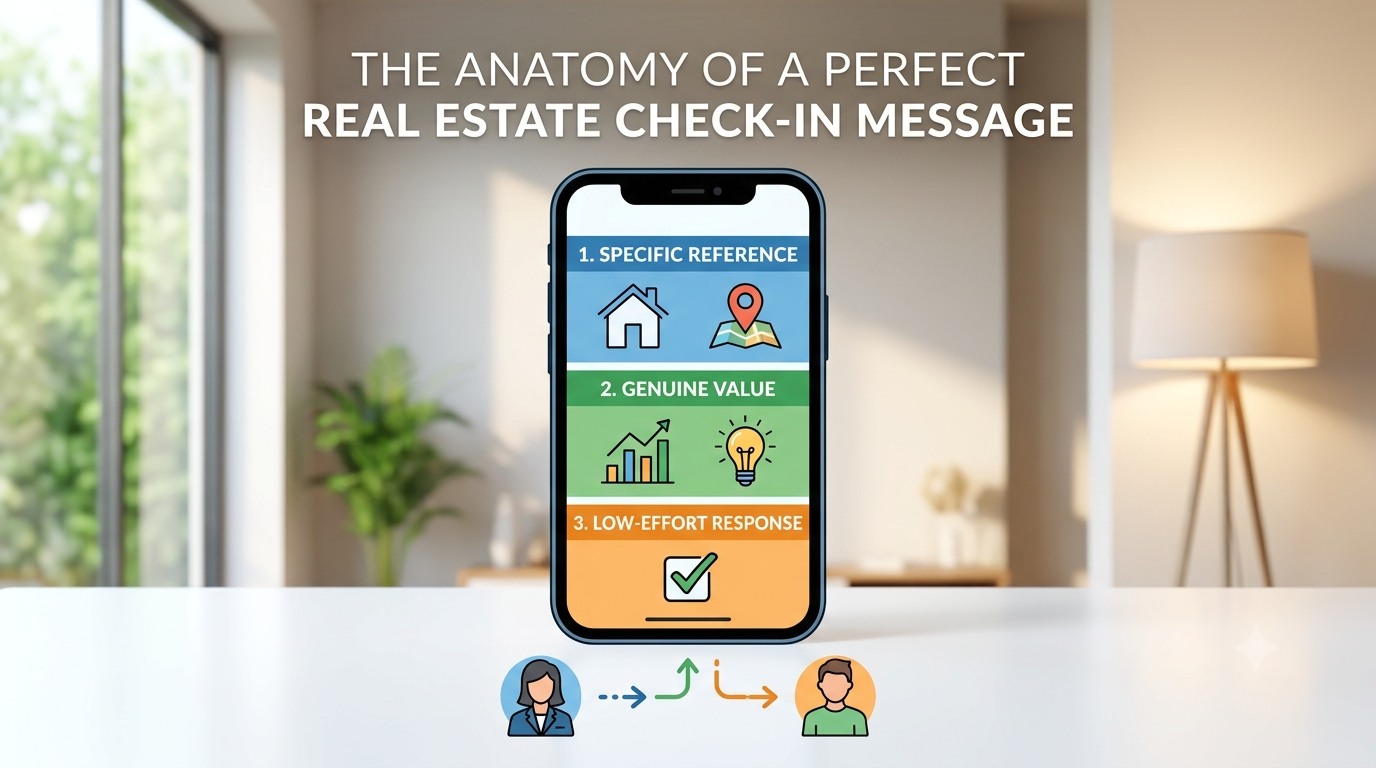
1. A specific reference. Open with something particular to that person's situation, whether that's a detail from a past conversation, their property, their neighborhood, or a stage they're at in the process. This signals the message wasn't sent to a hundred people at once.
2. A piece of genuine value. Include something useful: a relevant listing, a market insight, a helpful resource, or simply a piece of information they'd want to know. This gives the recipient a reason to read the message beyond obligation.
3. A low-effort way to respond. Close with a specific, easy question rather than an open-ended prompt. A yes-or-no question or a simple choice is far easier to answer than "let me know your thoughts," which requires the recipient to generate the entire response themselves.
A message built on these three elements feels like genuine attention rather than a scripted follow-up, even when it's sent as part of a structured cadence. This is the foundation of every effective real estate check-in message.
Check-In Messages by Relationship Stage
The right structure adapts slightly depending on where the relationship stands.
Early-stage leads benefit from check-ins that lead with relevant information, such as a new listing matching their criteria, paired with a specific question about their timeline or preferences.
Active clients benefit from check-ins tied to transaction milestones, offering a clear update and inviting any questions about the specific next step ahead.
Past clients in the first year after closing benefit from check-ins focused entirely on their experience in the home, with no transactional angle at all.
Long-term past clients and sphere-of-influence contacts benefit from check-ins built around genuine value, such as a market update or a personal note, without any explicit ask, letting the relationship itself carry the message.
What to Avoid in a Check-In Message
Generic openers with no specific reference. "Hope you're doing well" as an opening line, with nothing personalized following it, signals a template rather than genuine attention.
Messages that only ask, never offer. A check-in with no value included places the full weight of the interaction on the recipient's willingness to respond.
Open-ended questions with no easy answer. "Let me know your thoughts" requires more effort to answer than a specific, narrow question.
Overly long messages. A check-in should be brief enough to read in a few seconds. Length often signals a sales pitch rather than genuine outreach.
Repeating the same message structure every time. Even a strong check-in structure becomes noticeable and less effective if every message follows an identical pattern with no variation. A real estate CRM can help you rotate templates so every real estate check-in message feels fresh and personalized.
Adapting Tone by Channel
Text messages should be brief, conversational, and specific, closer to how you'd message a friend than a formal client. A single short question tends to perform better than multiple points packed into one text.
Emails allow slightly more detail and can include a specific resource, such as a linked market report or listing, but should still stay concise and avoid reading like a newsletter.
Phone calls allow for a more natural, adaptive conversation, but a brief mental outline, referencing something specific, offering value, and ending with an easy next step, keeps the call focused and useful even when unscripted. Nexxy provides conversation prompts and call scripts that help agents stay on track without sounding robotic.
Frequently Asked Questions
What should I avoid saying in a check-in message? Avoid vague openers with no specific reference, requests with no value offered in return, and open-ended questions that require significant effort to answer.
How long should a check-in message be? Generally, brief. A few sentences for a text or short email tends to outperform a longer message, since check-ins are meant to feel light and easy to engage with.
Should every check-in include a question? Not necessarily, especially for long-term past clients where the goal is simply staying visible. But when a response is genuinely useful, a specific, low-effort question increases the likelihood of engagement.
How often should I send check-in messages to the same contact? This depends on the relationship stage, but a consistent, moderate cadence, varied in content and channel, tends to outperform either infrequent, generic contact or overly frequent repetition of the same message. Nexxy's real estate operating system automates cadence management so every contact gets the right real estate check-in message at the right time.
Conclusion
A check-in message doesn't need to be clever or elaborate to work. It needs to demonstrate genuine attention, offer something of value, and make it easy for the recipient to respond. Agents who build their check-ins around this simple structure consistently generate more engagement than those relying on generic, templated outreach.
If you're looking for a better way to build stronger client relationships, stay organized, and communicate consistently, Nexxy was built with professionals like you in mind.