The Silent Killer in Your Pipeline
Most real estate agents do not lose leads because the market is too competitive. They lose them because of silence.
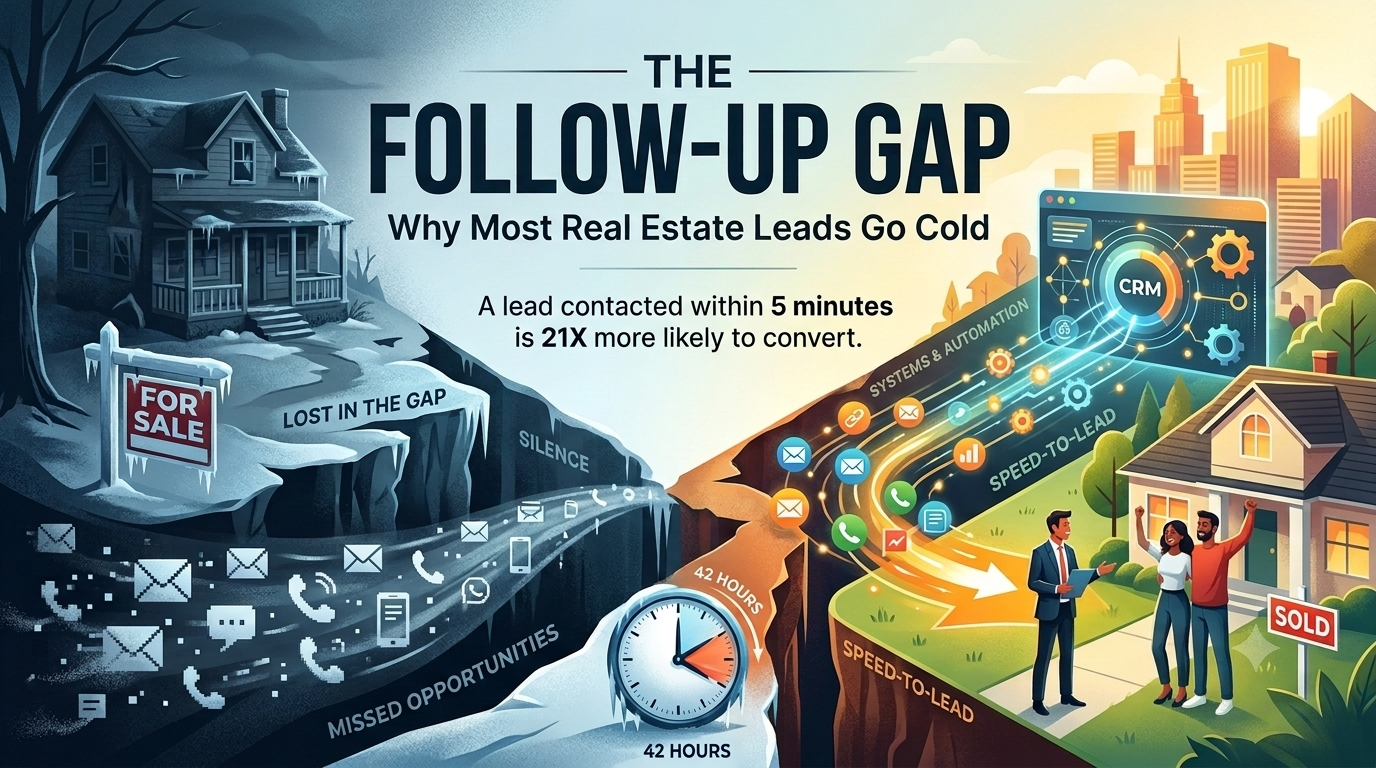
The average online lead is contacted within 42 hours of inquiry. Some are never contacted at all. In an industry where speed is currency, waiting even a few hours means the prospect has already moved on mentally — or worse, signed with someone who responded first.
This is the follow-up gap. It is not a marketing problem. It is not a lead quality problem. It is a systems problem. And it is costing agents more business than any market downturn ever could.
Pro Tip: Agents who use a dedicated real estate CRM to automate their first response cut their lead response time from hours to minutes — often before the prospect has even finished browsing listings.
Why the First Hour Matters More Than the First Week
Speed-to-lead is not a buzzword. It is a measurable competitive advantage backed by years of sales research. A lead contacted within five minutes is 21 times more likely to convert than one contacted after 30 minutes. After an hour, the probability drops sharply. After a day, it is nearly gone.
The reason is simple: intent decays fast. When someone fills out a contact form, requests a showing, or replies to an ad, they are in a moment of active interest. That window is narrow. The agent who reaches them while they are still in that mindset has a massive advantage over the one who reaches them after they have cooled off, gotten distracted, or started talking to someone else.
Yet most agents still treat lead response as something they will get to when they finish their current task, their current call, or their current showing. By the time they respond, the lead has already assigned trust to someone else.
The Three Stages Where Follow-Up Fails
Stage 1: The First Response
This is where the highest percentage of leads are lost. A prospect submits an inquiry and hears nothing for hours, or sometimes days. They assume disinterest, move on, and often never reply when the agent finally reaches out. The opportunity is not just delayed. It is dead.
Stage 2: The Nurturing Gap
Not every lead is ready to buy or sell immediately. Some are three months out. Some are six. Agents who only follow up with hot leads ignore the majority of their pipeline. Then, when those leads become active, they have no memory of the agent who never stayed in touch.
Stage 3: The Post-Closing Disappearance
The transaction ends, the file closes, and the agent moves on to the next deal. The client, who might have been a source of referrals and repeat business, is left in silence. By the time the agent thinks to check in, the relationship has gone cold.
Each of these stages represents a different kind of follow-up failure, but they share a common root cause: the absence of a reliable system.
Modern agents do not rely on memory. They rely on systems. Nexxy helps agents automate every stage of follow-up — from instant lead response to long-term nurture — without losing the personal touch that builds trust.
Why Memory Is Not a Strategy
It is tempting to believe that good intentions are enough. Most agents genuinely plan to follow up with every lead, every past client, and every referral partner. But intention does not scale. A busy agent juggling active transactions, showings, and negotiations cannot reliably remember to send the right message to the right person at the right time.
The result is predictable. Some leads get followed up with obsessively. Others are forgotten entirely. Some clients get three messages in a week. Others hear nothing for six months. This inconsistency does not just hurt conversion rates. It damages the agent's reputation.
Clients notice when follow-up feels erratic. They notice when they are chased aggressively during one phase and ignored during another. What feels like a busy schedule to the agent feels like unreliability to the client.
The agents who solve this do not have better memories. They have better systems.
What Effective Follow-Up Actually Looks Like
Effective follow-up is not about sending more messages. It is about sending the right message at the right time, consistently, across every stage of the relationship.
Immediate response. Within minutes of a lead inquiry, the prospect receives a personalized acknowledgment. Not an auto-reply that feels robotic. A message that confirms their interest, sets expectations, and opens a conversation.
Structured nurture. Leads that are not ready to transact immediately enter a light, value-driven sequence. Market updates, neighborhood insights, seasonal tips. The goal is not to sell. It is to stay present until they are ready.
Milestone check-ins. Past clients receive genuine, non-sales touchpoints at meaningful moments — closing anniversaries, market shifts, life events. These small signals compound into long-term loyalty.
Referral timing. The ask for referrals comes only after trust has been reinforced through consistent value, not as a cold request from someone who has been silent for months.
None of this requires hours of manual work. It requires a system that remembers so the agent does not have to.
Follow-up without a system is just hope. Nexxy's real estate operating system gives agents the automation, lead scoring, and daily briefings they need to stay present for every contact — without adding hours to their week.
How Automation Protects the Personal Touch
There is a common fear that automating follow-up makes communication feel impersonal. The opposite is true. Automation, done well, creates the consistency that makes personal moments possible.
When an agent no longer has to worry about remembering who to contact and when, they have more mental bandwidth for the actual conversation. The system handles the timing. The agent handles the human connection. Automation does not replace personalization. It creates the space for it.
The agents who master this balance send timely, relevant messages that feel personal because they are grounded in real client data — property interests, communication history, life events — rather than generic templates blasted to a list.
Measuring Whether Your Follow-Up Is Working
| Signal | What It Means |
|---|---|
| Lead response time under 5 minutes | Your first impression is competitive |
| Leads reply to nurture emails | Your value is landing, not just your name |
| Past clients refer without being asked | Trust has been maintained between transactions |
| Pipeline includes leads at multiple stages | You are nurturing, not just chasing hot prospects |
| Clients mention specific past conversations | Your follow-up feels personal, not automated |
If these signals are missing, the problem is almost never the quality of the leads. It is the quality of the follow-up system.
Frequently Asked Questions
How quickly should I respond to a new lead?
Within five minutes if possible. After 30 minutes, your odds of conversion drop dramatically. After a few hours, the lead has likely moved on.
What should my first message to a lead say?
Acknowledge their inquiry specifically, confirm you are available to help, and ask one simple question to open a conversation. Avoid long introductions or sales pitches in the first contact.
How often should I follow up with a lead that is not ready yet?
A light, value-driven touch every two to four weeks is usually enough to stay present without becoming annoying. The key is relevance, not frequency.
Will automated follow-up make me seem impersonal?
Only if it is generic. Automation that uses real client data — their property interests, their timeline, their past conversations — feels personal because it is grounded in actual context, not a template.
Conclusion: Close the Follow-Up Gap
The agents who dominate their markets are not necessarily the ones with the biggest ad budgets or the most listings. They are the ones who respond faster, nurture longer, and stay present after the transaction closes. They understand that follow-up is not a task to remember. It is a system to build.
Closing the follow-up gap does not require working more hours. It requires working with better tools. The right system turns missed opportunities into closed deals, cold leads into warm relationships, and one-time clients into lifelong advocates.
Ready to close the follow-up gap in your business? Nexxy was built to help agents automate lead response, nurture long-term relationships, and never let another opportunity slip through the cracks.
Explore more on real estate CRM features, lead nurturing strategies, and automation tools.