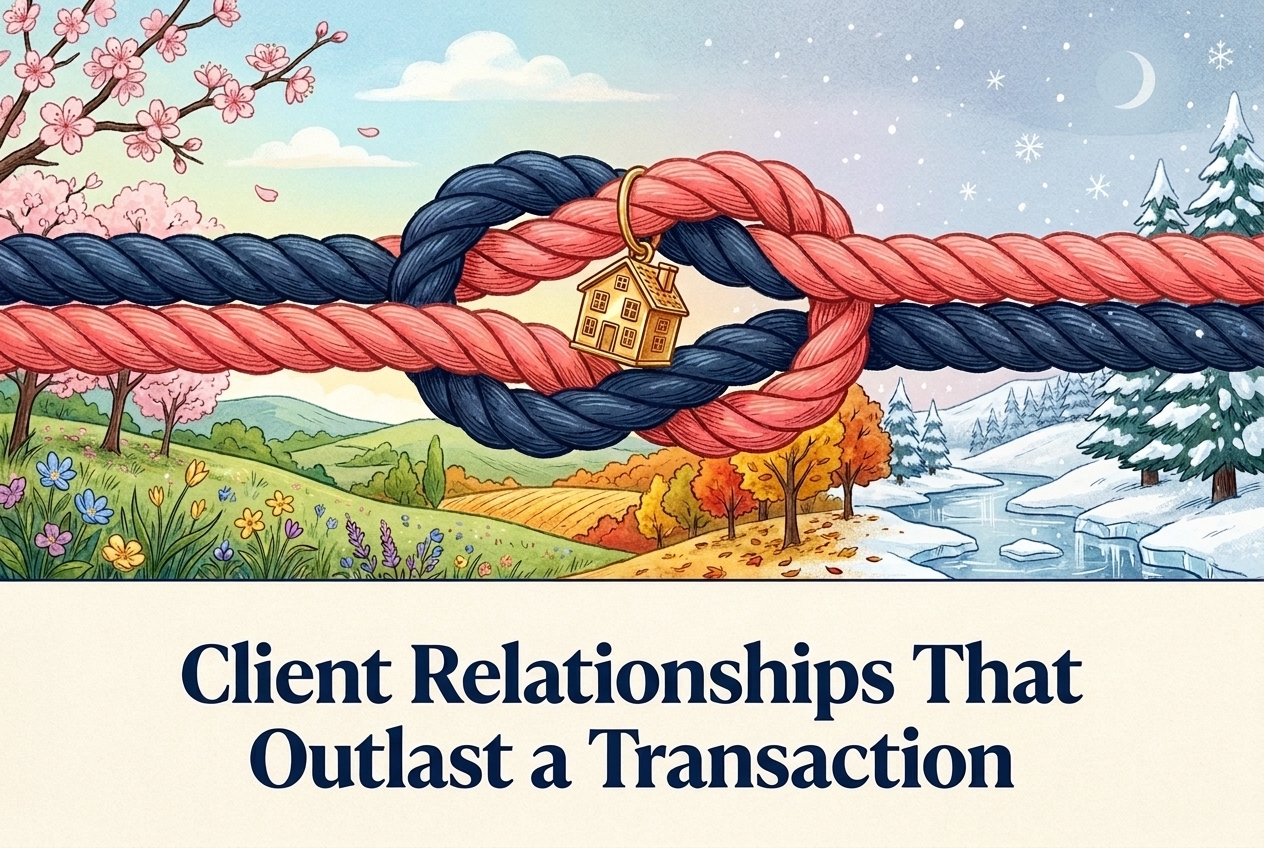
The Transaction Mindset vs. the Relationship Mindset
Every real estate agent operates, whether consciously or not, from one of two mental models.
The transaction mindset treats each deal as a discrete event with a clear beginning and end: a client appears, a home is bought or sold, a commission is earned, and the relationship effectively closes with the file. The relationship mindset treats the transaction as a single chapter within a much longer story, one that may include a second purchase, a sale years later, referrals to friends and family, and eventually, the client's own children becoming buyers themselves.
Both mindsets can produce a closing. Only one produces a career.
The distinction matters because client behavior increasingly rewards the relationship mindset. Research from the National Association of REALTORS® consistently shows that a majority of sellers and a substantial share of buyers find their agent through referral or a past relationship, not marketing. That pattern isn't an accident. It reflects how people actually make high-stakes decisions: through people they already trust.
Pro Tip: Agents who use a dedicated real estate CRM to manage long-term real estate client relationships find it far easier to stay organized and maintain consistent follow-up without letting anyone slip through the cracks.
Why Most Real Estate Client Relationships End at Closing
If relationships that outlast a transaction are so valuable, why do so few agents actually build them? The honest answer is that closing day creates a natural stopping point, and without a deliberate reason to continue, most professional relationships default to silence.
There's also a subtler reason: many agents unconsciously treat post-closing outreach as a sales activity, and feel awkward reaching out without a clear "ask." This hesitation is understandable, but it misreads what clients actually want. A thoughtful check-in with no immediate transaction attached doesn't feel like a sales pitch to a client. It feels like being remembered.
The agents who build real estate client relationships that last treat post-closing contact as a continuation of good service, not a new sales campaign. That reframing changes both what they say and how often they say it.
What a Lifetime Real Estate Client Relationship Actually Looks Like
A relationship that outlasts a single transaction typically moves through a series of moments extending far beyond the closing table:
A young couple buys their first home with your help. Five years later, a growing family prompts a move to a larger property, and they call you again without considering anyone else. A decade after that, their parents are downsizing, and your name comes up naturally in conversation. Fifteen years in, their own children are entering the market, and the family relationship becomes a second-generation client relationship.
None of this happens automatically. It happens because the agent stayed present, in small and genuine ways, across the years between transactions. The alternative — going quiet after each closing — means starting from zero credibility every time a new opportunity arises, even with people who already had a positive experience.
Building long-term real estate client relationships starts with the right tools. Nexxy helps agents automate follow-ups, track client milestones, and stay genuinely present for every person in their database.
The Four Phases of a Real Estate Client Relationship That Outlasts a Sale
Phase 1: The Transaction Itself
This is where trust is initially earned, through competence, communication, and follow-through. It sets the ceiling for everything that follows; a rushed or transactional experience here makes long-term relationship-building far harder later.
Phase 2: The First Year After Closing
This is the highest-risk period for relationship decay. Clients are settling into a new home and naturally think about their agent less. A structured cadence of check-ins, seasonal tips, and market updates prevents the relationship from going cold during this window.
Phase 3: The Established Relationship (Years 2 through 5)
Contact becomes less frequent but should remain genuine: an annual market update, a holiday note, a congratulations message for a life event mentioned in passing. The goal here isn't frequency. It's relevance.
Phase 4: The Long-Term Relationship (5+ Years)
By this stage, many clients are approaching their next natural transaction, whether that's a move, a sale, or a referral to someone else who is. Agents who maintained visibility through Phases 2 and 3 are the ones who get the call.
Practical Ways to Stay Relevant Between Transactions
Staying relevant doesn't require constant contact. It requires the right contact at the right moments.
- Send a genuine, specific thank-you shortly after closing, referencing something particular to that client's experience rather than a generic template
- Check in a month later to see how they're settling in, separate from any transactional purpose
- Share seasonal home maintenance guidance relevant to their specific property type
- Send an annual market update that shows how their neighborhood has performed, framed around their interests rather than a sales pitch
- Acknowledge major life events when you become aware of them, such as the birth of a child or a career change
- Mark the anniversary of their closing with a brief, warm note
- Introduce them to useful local resources, such as trusted contractors, without expectation of anything in return
Each of these works because it demonstrates ongoing attention without demanding anything back. That asymmetry — giving without immediately asking — is what separates relationship-building from disguised prospecting.
Want a system that helps you remember every milestone and stay genuinely present? Nexxy's real estate operating system was built to help agents nurture real estate client relationships at scale.
Common Mistakes That Cut Real Estate Client Relationships Short
Only reaching out when there's a transaction to discuss. Clients notice when contact only appears alongside a sales opportunity, and it undermines the sense that the relationship was ever genuine.
Inconsistent timing. A relationship built on sporadic, unpredictable contact feels less reliable than one built on a modest but consistent cadence.
Generic, templated messaging. Mass-blast market updates with no personal relevance read as marketing, not relationship maintenance.
Losing track of client details. Forgetting a client's name, property, or key life details on a later call damages the very trust the relationship was meant to build.
Assuming the relationship will maintain itself. Goodwill from a great transaction experience fades if it isn't reinforced. Real estate client relationships require light, ongoing maintenance, not a single strong first impression.
How to Know a Real Estate Client Relationship Is Working
| Signal | What It Suggests |
|---|---|
| Client responds warmly to check-ins, not just transactional messages | Relationship, not just service, was delivered |
| Client mentions you to friends unprompted | Trust has reached advocacy level |
| Client returns for a second transaction without shopping around | Loyalty has replaced comparison shopping |
| Client shares personal updates over time | Genuine rapport, not just professional courtesy |
| Client introduces family members as future clients | Multi-generational relationship potential |
If these signals are largely absent a year or two after closing, it's worth revisiting the post-transaction follow-up cadence rather than assuming the relationship simply ran its course.
Frequently Asked Questions
How often should I contact past clients to maintain real estate client relationships?
A general benchmark is quarterly contact at minimum, supplemented by key milestones such as closing anniversaries, holidays, and relevant market shifts. Consistency matters more than frequency.
What should I say when I don't have a specific reason to reach out?
Lead with value or genuine interest rather than a sales angle: a market update relevant to their neighborhood, a seasonal home tip, or simply checking in on how they're settling in.
How long does it typically take before a past client becomes a repeat client or referral source?
This varies widely, but many agents see referral activity begin within the first one to two years, with repeat transactions often occurring five to ten years later depending on the client's life stage and housing needs.
Is it worth the effort to maintain real estate client relationships with starter-home buyers?
Often, yes. Starter-home buyers are frequently the clients most likely to move again within a few years as their needs change, making them a strong long-term relationship investment.
Conclusion: Real Estate Client Relationships Are the Real Asset
The transaction is the beginning of the relationship, not its conclusion. Agents who treat closing day as an ending will always be rebuilding trust from scratch with every new prospect. Agents who treat it as the first chapter build a business that compounds, one relationship at a time, long after any single sale is complete.
Ready to build real estate client relationships that last? If you're looking for a better way to stay organized, communicate consistently, and nurture leads without letting anyone slip through the cracks, Nexxy was built with professionals like you in mind.
For more insights on building a referral-driven business, explore our guides on client follow-up systems, lead nurturing strategies, and real estate automation.